Fox Is Airing a Girlboss Version of the Old Testament
The Faithful: Women of the Bible has a whiff of feminism to it. Then I looked more closely.
Sign up for the Slatest to get the most insightful analysis, criticism, and advice out there, delivered to your inbox daily.
We’re in a Bible-curious time for popular media. In the past year, star-studded animated movies about Jesus and the patriarch David each made more than $80 million in theatrical runs, proving biblical films can be powerful contenders at the box office. On streaming services, there have recently been a number of Scripture-based shows, including the Exodus comedy The Promised Land; Amazon’s sword-and-sandals fantasy series House of David; a coming Joseph of Egypt drama; and, most importantly, the mega-hit New Testament drama The Chosen, which proved to studios that there was a rabid market for faith-based content in the first place.
It seems that everyone is suddenly waking up to the potential for this particularly well-known material. And in the scramble to put its own contribution forward, Fox, with its new series on the biblical matriarchs, is testing out whether, beyond big-budget movie epics and narrowly targeted streaming shows, biblical stories might draw these viewers to traditional television.
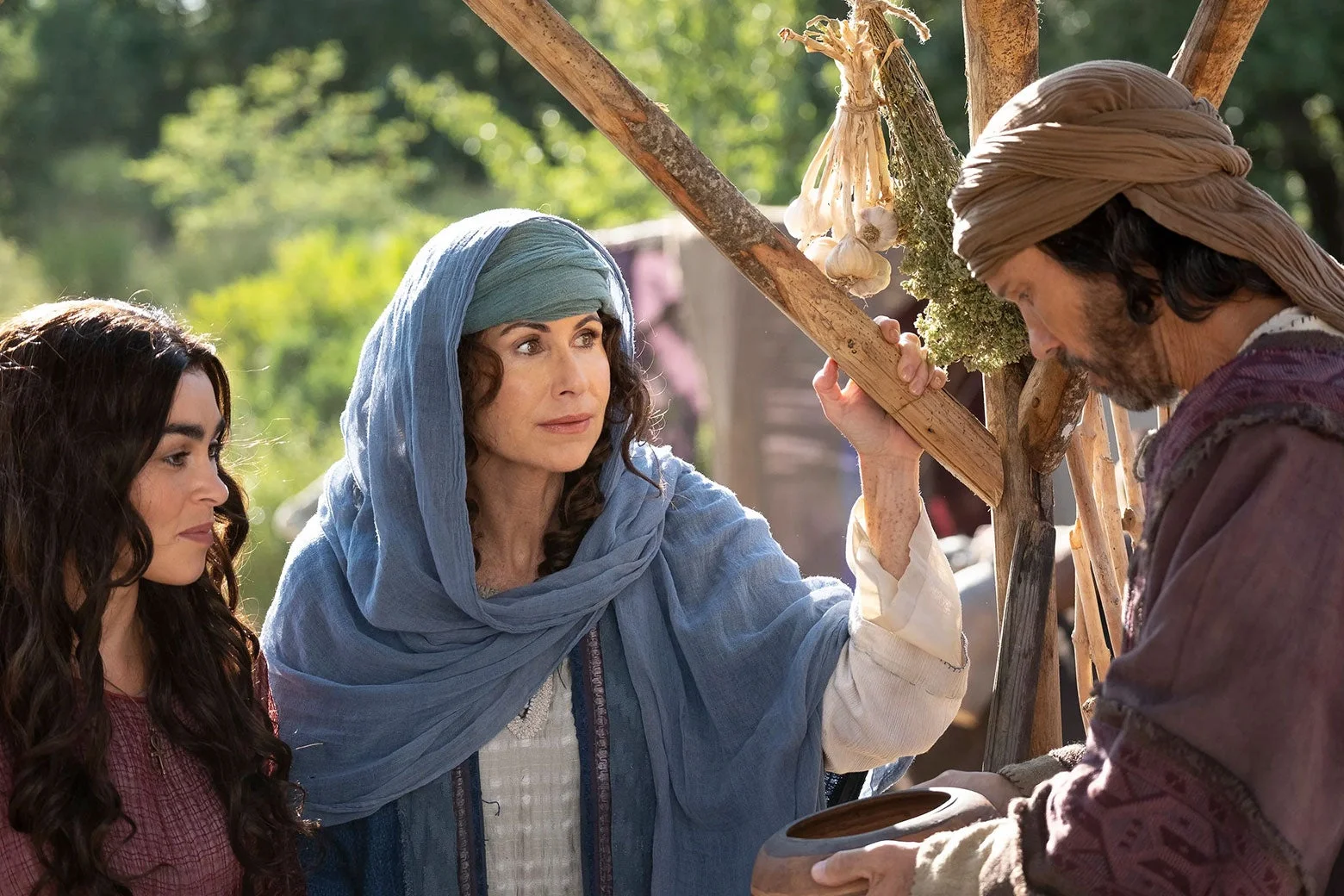
The Faithful, a three-week “event series” tied to Easter and debuting Sunday in a prime-time slot (and streaming the next day on Hulu), hopes to excite audiences with the promise of religious storytelling with a fresh angle and a big name: Its first two episodes, about Abraham’s wife and her handmaid, star Minnie Driver as Sarah. (Driver is not herself religious, at least publicly, but said during a promotional event that she has long “been drawn to playing women who take big leaps of faith, whether romantically, spiritually or morally.”) The idea, to focus on retelling the stories through “the rarely heard perspective of the women of the Bible,” has a whiff of feminism to it that seems to tease something new. But what it actually delivers is something else—a crushingly dull offering that might be a genuine liability for the movement it’s trying to tap into. The series, from writers whose credits include Castle, Teen Wolf, and many iterations of CSI, isn’t just tired and formulaic. It’s also so contorted in its own gender politics that it lays bare just how limited its model—the one so many see as the path forward for religious media—really is.
The story of Sarah, wife of Abraham—or Sarai and Abram, as they’re known for most of the show—is admittedly a challenging one. The biblical story is oriented around concerns with genealogy and bloodlines: She cannot have children, so to produce an heir, she instructs her slave, Hagar, to have sex with her husband. When the pregnant Hagar becomes contemptuous, Sarah mistreats her, causing her to flee. Miraculously, in her old age, Sarah then has her own child, Isaac. When tensions between these offspring arise, she casts Hagar and her son, Ishmael, out into the wilderness, where they nearly die. To make Sarah more palatable, The Faithful makes Hagar more of a consenting party in the arrangement, with gratitude and love for Sarah, and gives Sarah a secret noble motivation for casting out Hagar and Ishmael. (It also skips the binding of Isaac.)
But the real problem with Driver’s Sarah is that she is, bafflingly, not just an Old Testament matriarch but an occasional girlboss. (The show has a clear Christian bias; its promotional material speaks of the Old Testament rather than the Hebrew Bible.) Setting aside Driver’s distractingly age-suspended face, Sarah seems misplaced in time by her dialogue, fit for a feisty Regency heroine: “Marrying a man I hardly know? Much less admire? I think not.” She tries to stab Pharaoh (a creative liberty) and puts her whole crew in danger when she refuses to prostrate herself before him. She hopes her son will marry a woman who is “fearless and full of adventure.” At one point Abraham pronounces that she was “always the stronger one.” And for reasons that are never explained to the viewer, she tells us, “I decided long ago I would bow to no man.”
The issue with girl-power Sarah is that the show pretends to be something it isn’t, with Driver’s pluckiness as a kind of mask for its actual tradwife spirit. Cool, a viewer might think, a woman is the main character! She’s strong-willed and courageous, and she stands up to powerful men!—without noticing that her only motivation, the whole time, is to have children and to please her husband, whom she describes to Hagar as “her world.” She tells Abraham, in introducing the subject of her barrenness, “I failed you.” She even pleads with God to make her fertile not for her own sake, but “for him, for Abraham, your faithful servant. Please let him have this child.” Those motivations make sense for the biblical Sarah, composed as a character in the ancient world, but they don’t track for the headstrong female protagonist the writers want us to see.
This faux-empowerment in the character isn’t just a sign of inconsistent writing and the messiness that comes from shoehorning modern family dynamics into ancient texts. It has actual political significance when you know that framing tradwife values as a matter of female empowerment is a common tactic of the Christian right. To be clear, the show’s creators haven’t indicated any political interest; they have only said, in discussions with reporters, that they wanted to tell overlooked stories from the Bible with an eye to expanding audiences for faith-based content. But there’s still unwitting politics in what they’ve produced: Many deeply conservative churches that don’t believe in women having any power over men reassure women that their strength is elsewhere, in home life. Influencers argue this, too: It takes admirable fortitude to bear and raise children and keep a home. It takes courage and strength to defy the pressures of secular society and choose to be a traditional wife. This thinking buttresses arguments from people who want to trap women in domestic spheres—a cohort with growing political power. Some of the most hardcore fundamentalist evangelicals might not like young Sarah’s initial defiance, when pressed by her parents to marry, but they can’t quibble with adult Sarah’s blind faith in her husband and “his God.” The Faithful isn’t just a dreary show with lifeless dialogue; it’s also, even if the writers don’t intend it, propaganda.
But perhaps that won’t matter too much: this show will almost certainly fail to trigger a word-of-mouth phenomenon the way The Chosen did. The Chosen, which began airing in 2019, follows the life of Jesus and his disciples. This venture has advantages over The Faithful. It’s a longer series, for one, with more room for things to breathe. But the subject material also helps: The New Testament was written hundreds of years after Genesis, which in turn depicts events set in distant prehistory. The Chosen can depict specific details and customs, building out a rich world for its characters to inhabit; Sarah’s Levant is much hazier, so the sets and scenes in The Faithful seem generic and stiff. As characters, Jesus has a motivation legible to modern audiences—changing hearts and gathering supporters—while Abraham has demographic-level concerns to do with claiming and populating a land. The Faithful tries to humanize its heroes by making Sarah’s quest for a child more personal, but it neither embraces nor fully avoids the alienness of the ancient world—slavery, polygyny, territorial gods, and animal sacrifices, for example—leaving it with an awkwardly half-sanded version of the tale, neither fascinatingly brutal nor freshly modern; neither faithful to the spirit of the text nor feminist. The in-between comes off as lacking any kind of conviction.
In its inability to find its way through the genre’s particular challenges, The Faithful provides what to many Christian audiences might be a disappointing minor setback. It had seemed that after years of faith-based media earning a reputation for being cringeworthy or painfully bland, biblical stories were finally getting quality investment and becoming interesting. But The Faithful, trying to cash in on a moment of audience enthusiasm, is instead further evidence of just how hard it is to make the stories of the Bible feel modern while still creating compelling art. There may well be a robust audience for stories about biblical women. But if Christian producers are trying to keep the momentum going on faith-based media by proving they can pull compelling female characters from Scripture, The Faithful is a strike against them.